
TYPE
TOPIC
Research is arduous. The excitement of starting a project is often overshadowed by long days, difficult conditions and months – if not years – of work, all without the certainty of success.
For University of Wisconsin-Superior students Ashla Ojibway and Valerie J. Ross Zhaawendaagozikwe, those challenges were very real. But their journey ended on a much brighter note.
A NATIONALLY RECOGNIZED SCIENTIFIC BREAKTHROUGH
The project they joined was recently published in the prestigious Proceedings of the National Academy of Sciences (PNAS), a peer-reviewed journal of the National Academy of Sciences (NAS). According to its website, PNAS is an authoritative source of high-impact, original research spanning the biological, physical and social sciences, with global reach and open submission.
“One of the things I’m most proud of about the PNAS manuscript is how collaboratively it was written,” said Evan Larson, professor of environmental sciences and society at the University of Wisconsin-Platteville, who led the research. “We were thoughtful and patient, and as a result, the manuscript was truly co-produced. It uplifts both Indigenous knowledge and Western science in a way that could serve as a model for other projects.
That this work helped advance efforts to restore fire so quickly is incredible – I think it shows how fire can bring people together, contribute to healing the land and, at the same time, ourselves.”
TESTING A CENTURY-OLD HYPOTHESIS
The research on Wisconsin and Minnesota Points stemmed from over a decade of work across the Upper Great Lakes region.
“At sites like the Boundary Waters, Quetico, Voyageurs National Park, the Cloquet Forestry Center and others,” said Larson. “We kept seeing a consistent pattern: fire events were recorded in tree rings throughout the 1700s and 1800s, but they declined sharply in the late 1800s and early 1900s.”
The project on Wisconsin and Minnesota Points aimed to test a hypothesis: given the cultural significance of these places, researchers expected to find a similar pattern – frequent fires tied to traditional land tending, followed by a sharp decline after colonization, treaties and forced relocation.
“It was a bold move,” Larson admitted. “If we saw that same pattern here, it would affirm our understanding. If not, it would challenge what seemed to be an emerging picture of the relationship between people, fire, and red pine in the Great Lakes region.”
AN UNPRECEDENTED COLLABORATION
A project of this scale succeeded thanks to a diverse group of collaborators.
“The project was incredibly collaborative,” Larson said. “Elders from Fond du Lac provided guidance and ceremony. The Fond du Lac Council supported the work, as did the cities of Duluth and Superior and the Minnesota DNR.
“We had amazing contributions and support from the Lake Superior National Estuarine Research Reserve, and the Duluth Maker Space generously gave us access to their shop in the middle of winter for tree-ring sample processing.
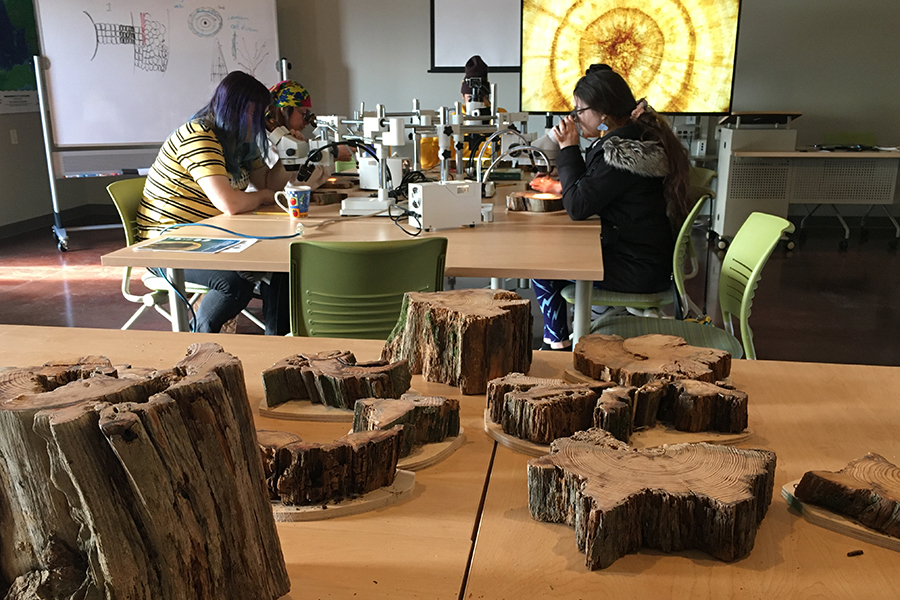
“The student crew from Fond du Lac Tribal and Community College was phenomenal and really drove the project forward. We also had help from the K–12 Gidaa Science Camp in analyzing tree-ring samples, and staff from the Cloquet Forestry Center were instrumental in both field work and data analysis.
“The list goes on – staff from the Fond du Lac Fire program, the Fond du Lac Tribal Historic Preservation Office and community members, both Indigenous and non-Indigenous, all played a part. It was overwhelming in the best way – just a beautiful collaboration connecting so many people to these special places.”
A PERSONAL AND CULTURAL CONNECTION TO THE LAND
Ojibway and Zhaawendaagozikwe, who began as two of the four student researchers from Fond du Lac Tribal and Community College before transferring to UW-Superior, found the project aligned perfectly with their passions.
“I really liked the job description,” said Zhaawendaagozikwe, a double major in environmental science and biology who is set to graduate this spring. “The first paragraph was all in Ojibwe. That stood out – you just don’t see that. I really appreciated it and wanted to be a part of it.”
What they signed up for was a deep exploration of how Indigenous cultures used fire to care for the land.
“This is my home, and this is my ceded territory,” said Ojibway a senior majoring in environmental science with a minor in geographic information systems (GIS). “I’m a member of the Fond du Lac Band of Lake Superior Chippewa. This opportunity came through an email. Three of my classmates and I applied – and we all got it. It was great because we had already worked together as a research team. These are my ancestors we’re talking about. I love history, I love science, and combining the two is one of the coolest things ever.”
HOLDING HISTORY IN THEIR HANDS
The researchers searched for culturally modified trees – especially those affected by fire. These clues help reveal how Indigenous peoples used fire to enhance and sustain the landscape.
“We were looking at red pines for fire scars and peel scars,” said Zhaawendaagozikwe. “Red pine preserves these marks well, especially because of our long, cold winters.”
Peel scars offer insight into the harvesting of pine sap, which was used by Indigenous peoples to build and waterproof canoes.
“Holding history in your hands and knowing that one of my ancestors may have been part of this – that was incredible,” said Ojibway. “That was the biggest part for me – being able to see and touch that history.”
Tree rings – gathered without harming any living trees – helped determine when burns occurred on Wisconsin Point and how fire was used to care for the land.
A PRESCRIBED BURN WITH PURPOSE
But perhaps the most exciting part of the project is what comes next: fire is returning to Wisconsin Point – not as a wildfire, but as a tool for cultural and ecological renewal.
As reported by Wisconsin Public Radio, for the first time in generations, the Fond du Lac Band of Lake Superior Chippewa and the Superior Fire Department have conducted a cultural prescribed burn on the narrow spit of land jutting into Lake Superior. The goal was to remove invasive species, return nutrients to the soil, support native plants, and honor the sacred relationship between the Ojibwe people and the land.
A similar prescribed burn is planned for Duluth’s Minnesota Point.
“It’s amazing,” said Ojibway. “I couldn’t be prouder of everyone who worked on this project. Being surrounded by people so dedicated to making this happen – and now seeing it come to life – it’s just an amazing feeling.”